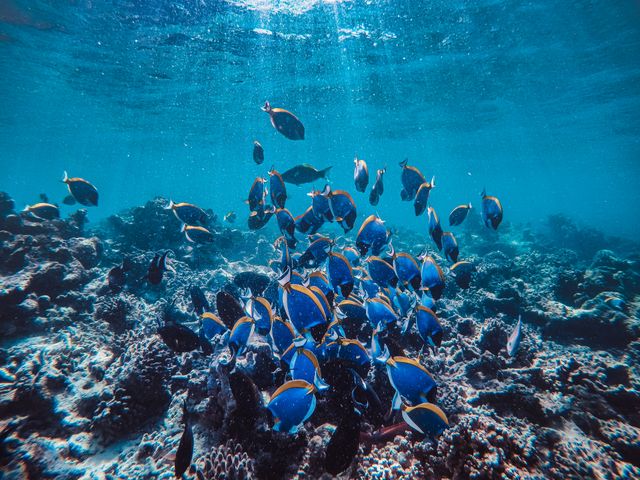
Coral reef fishes are among the least protected vertebrates in international wildlife trade. Although millions of coral reef fishes are traded every year, only a handful of species are currently monitored under international agreements. For most species, there is still no comprehensive system recording which species are traded, where they originate, or whether trade is sustainable. [1][2]
Protecting coral reef fishes therefore begins with one essential requirement: knowing what is being traded.
~ ~~ 🛡️ ~~ ~
Why protection is difficult
Unlike elephants, whales or rhinos, coral reef fishes comprise more than 4,000 species, many of which remain poorly studied. [1]
For many species, we still lack basic information on biology, such as reproductive biology, ecology, population size, distribution and conservation status. For most species, we also lack reliable international trade data. [2][3]
Without this information, assessing whether international trade is sustainable becomes extremely challenging.
~ ~~ 🛡️ ~~ ~
~ ~~ 🛡️ ~~ ~
CITES
The world’s wildlife trade agreement
(Small CITES logo or conference photograph.)
The Convention on International Trade in Endangered Species of Wild Fauna and Flora (CITES) is the world’s main international agreement regulating trade in wild animals and plants. Its aim is to ensure that international trade does not threaten the survival of wild species. [4]
Contrary to a common misconception, CITES does not automatically prohibit all trade. Most species listed under CITES are included in Appendix II, meaning that international trade may continue, but only if it is legal, regulated and not detrimental to the survival of the species in the wild. [4]
Today, more than 180 Parties cooperate through CITES to regulate international wildlife trade. [4]
~ ~~ 🛡️ ~~ ~
Marine ornamental fishes at CITES
In 2019, following several years of scientific research and policy engagement, the European Union, the United States and Switzerland jointly submitted the first CITES document dedicated specifically to the conservation, management and trade of marine ornamental fishes: CoP18 Doc. 94. [5]
The proposal was adopted at CITES CoP18 in Geneva, marking the first time that CITES Parties formally recognised the need to examine this global wildlife trade. The resulting Decisions called for further work on the conservation priorities and management needs of non-CITES-listed marine ornamental fishes in international trade. [5][6]
Subsequent work brought together scientists, governments, conservation organisations and other stakeholders to evaluate current knowledge and identify priority actions. Although progress was delayed by the COVID-19 pandemic, the issue remained on the CITES agenda. At CoP20 in Samarkand in 2025, Parties adopted CoP20 Doc. 92 as amended, continuing the CITES work on marine ornamental fishes. [7][8]
~ ~~ 🛡️ ~~ ~
Why monitoring matters
Protecting wildlife begins with understanding wildlife trade.
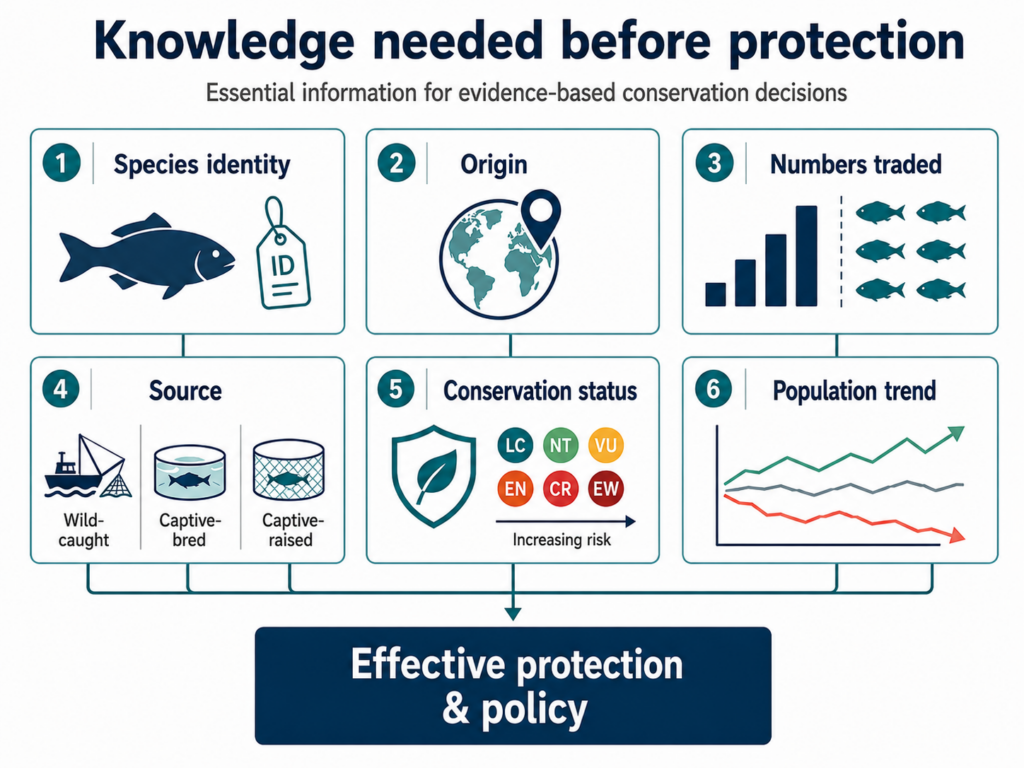
Surprisingly, no comprehensive international system currently records all coral reef fish species entering international trade. As a result, many fundamental questions remain unanswered:
- Which species are traded?
- How many individuals are collected?
- From which countries?
- Are they wild-caught, captive-bred or captive-raised?
Without this information, conservation decisions are often based on estimates rather than measured evidence. [2][3][9]
~ ~~ 🛡️ ~~ ~
A practical solution: TRACES
The European Union and Switzerland already operate one of the world’s most advanced electronic systems for monitoring the movement of live animals: the Trade Control and Expert System (TRACES).
Originally developed to protect animal and public health, TRACES already records large numbers of live animal movements. Our research demonstrates that, with relatively modest modifications, TRACES could also become one of the world’s most effective systems for monitoring the international trade in coral reef fishes. [9][10]
The principal improvements would include:
- recording each species and the corresponding number of individuals within every consignment;
- recording the country of origin;
- recording whether specimens are wild-caught, captive-bred or captive-raised;
- making anonymised trade data available for scientific research and conservation.
Species-level recording does not mean tagging every fish. It means recording the scientific name, number, origin and source—wild-caught, captive-bred or captive-reared—of each species in a shipment. This information must remain linked to the shipment throughout the supply chain.
These improvements would not require the creation of a completely new monitoring system. Instead, they would build on an existing electronic platform that is already used for legal imports of live animals into the European Union. [9][10]
~ ~~ 🛡️ ~~ ~
Which species are already protected by CITES?
Only two coral reef fishes and a coral reef fish group also a traded for marine aquariums are currently listed under CITES.
| Species / group | CITES listing | Main reason for protection |
|---|---|---|
| Seahorses (Hippocampus spp.) | Appendix II | International trade for traditional medicine, curios and aquariums |
| Napoleon / humphead wrasse (Cheilinus undulatus) | Appendix II | Mainly live reef food fish trade; conservation concern; some aquarium trade |
| Clarion angelfish (Holacanthus clarionensis) | Appendix II | Aquarium trade and restricted eastern Pacific distribution |
These examples show that CITES can regulate marine fish trade when conservation concern and trade pressure are recognised. However, they also illustrate how few coral reef fishes are currently covered by international trade controls compared with the thousands of species known to occur in the marine ornamental fish trade. [2][11][12][13]
| CASE STUDY: Banggai cardinalfish — a species considered twice for CITES listing The Endangered Banggai cardinalfish (Pterapogon kauderni) is endemic to Indonesia and has been collected in large numbers for the international marine aquarium trade since the mid-1990s, as documented in the 2007 US Appendix-II proposal and the 2016 EU proposal. Its inclusion in CITES Appendix II has been proposed twice. In 2007, the United States submitted CoP14 Prop. 19; the proposal was withdrawn after discussion at CoP14. In 2016, the European Union submitted CoP17 Prop. 46. The CITES Secretariat concluded that Pterapogon kauderni met the criteria for inclusion in Appendix II, meaning that without regulation of its trade, the species could become eligible for the much stricter protection of Appendix I in the near future. The Secretariat therefore recommended that the Appendix-II proposal be adopted. The 2016 FAO Expert Advisory Panel independently found that the observed serial depletion of subpopulations met the Appendix-II listing criteria. The EU proposal was nevertheless withdrawn. CITES subsequently continued to follow the species. A study on the impact of international trade was considered by the Animals Committee in 2018, and at CoP18 in 2019 Parties adopted Decisions 18.263–18.265 encouraging continued conservation and management measures in Indonesia. At the same meeting, Parties also adopted the broader marine ornamental fish initiative in CoP18 Doc. 94 and Decisions 18.296–18.298, launching CITES work to examine conservation priorities, trade, management, regulation and enforcement for non-CITES-listed marine ornamental fishes, including through technical studies and a workshop. At AC31, Indonesia reported progress including population surveys, a marine protected area, monitoring and rehabilitation guidance, and a harvest quota. Fondation Franz Weber and other conservation organisations expressed continuing concern and recommended that the species remain on the CITES agenda. At CoP19 in 2022, Decisions 18.263–18.265 were deleted following the progress reported by Indonesia. The species itself was not added to the CITES Appendices. Indonesia’s second National Action Plan for the conservation of the Banggai cardinalfish covered 2022–2024, so its stated implementation period ended in 2024. Indonesia continues to regulate use nationally; for 2026 it has set a national export quota of 38,000 wild-caught P. kauderni (the 2025 quota was also 38,000). The Banggai cardinalfish nevertheless remains outside the CITES Appendices. Its international trade is therefore not subject to the standard Appendix-II requirements of CITES, such as export permits and non-detriment findings, nor to the Convention’s normal annual trade-reporting obligations for listed species. Separate national or regional measures may still apply. In the EU, for example, the species is included in Annex D of the EU Wildlife Trade Regulations, which requires imports to be notified and monitored. However, Annex D reporting does not require purpose and source codes, so the available data provide limited information on the purpose of trade and almost no information on whether specimens are wild-sourced, captive-born or captive-bred. Why it matters The Banggai cardinalfish shows how a threatened, internationally traded marine ornamental fishes can receive repeated attention within CITES — including two listing proposals, a Secretariat finding that Appendix-II regulation was needed to avoid possible eligibility for Appendix I, and an FAO finding that the Appendix-II criteria were met — while international trade in the species itself remains outside the Convention’s listing, permitting and species-specific reporting system. The Banggai Cardinalfish and CITES — Two listing proposals, fifteen years of international scrutiny — and still outside the CITES Appendices [PDF] |
~ ~~ 🛡️ ~~ ~
The IUCN Red List
The IUCN Red List of Threatened Species is the world’s most comprehensive assessment of species’ extinction risk. [14]
It does not regulate trade or provide legal protection. Instead, it compiles scientific information on species’ distribution, population trends, habitat, ecology, threats, use, trade and conservation actions. [14]
For many coral reef fishes, however, information remains incomplete. Numerous assessments are more than ten years old, and some traded species have never been assessed. Consequently, the absence of trade information or identified threats should not be interpreted as evidence that a species is unaffected by international trade. [2][3][14]
~ ~~ 🛡️ ~~ ~
Early voluntary industry initiatives
Before governments began considering comprehensive monitoring systems for the marine ornamental fish trade, several voluntary initiatives sought to improve transparency and promote more sustainable practices.
Marine Aquarium Council (MAC)
Established in 1998, the Marine Aquarium Council (MAC) developed voluntary certification standards to promote environmentally and socially responsible collection and trade of marine ornamental organisms. The programme aimed to certify the entire supply chain—from reef to retailer—by establishing standards for collection, handling and traceability. [15]
However, implementing and maintaining certification across thousands of species, numerous countries and many independent actors proved extremely challenging. The programme ceased operating in 2008 and has not been replaced by a globally recognised certification scheme, although some businesses continue to refer to the MAC label today. [15][16]
Global Marine Aquarium Database (GMAD)
Established in 2000 by UNEP-WCMC, MAC and aquarium trade associations, the Global Marine Aquarium Database (GMAD) was the first international initiative to compile species-level trade data for marine ornamental organisms. [15]
Based on voluntary submissions from 58 wholesalers, approximately 20% of the global trade, and four government authorities, the database represented an important first step towards greater transparency. However, participation remained voluntary, substantial discrepancies between importer and exporter records were identified, and no new data were entered after 2003. GMAD was therefore not maintained as a permanent global monitoring system. [15][16]
~ ~~ 🛡️ ~~ ~
From voluntary initiatives to electronic monitoring
Recognising the limitations of voluntary approaches, the European Commission commissioned UNEP-WCMC in 2008 to evaluate existing mechanisms for monitoring the international ornamental fish trade. The consultation paper compared six governmental and non-governmental approaches, including GMAD, MAC certification, customs statistics, veterinary controls, CITES and the EU Wildlife Trade Regulation. [16]
The report concluded that voluntary initiatives had provided valuable experience but were unable to deliver comprehensive, long-term monitoring because participation depended on voluntary reporting and continued funding. Government-operated systems were identified as the most practical basis for reliable trade monitoring. [16]
Many of the recommendations made in 2008 anticipated developments that have since become possible through TRACES. Today, legal imports of live marine ornamental fishes into the European Union from third countries are processed through TRACES, and our analysis of imports between 2014 and 2021 showed that approximately 70% of imported marine ornamental fishes were already recorded at species level, while around 30% were still reported only at family level. [2][9][10]
Recording all marine ornamental fishes consistently at species level, together with their country of origin and source—wild-caught, captive-bred or captive-raised—would transform TRACES into one of the world’s most comprehensive electronic monitoring systems: not only for the marine ornamental fish trade, but more broadly for legal international wildlife trade imports.
~ ~~ 🛡️ ~~ ~
References
[1] Fisher, R. et al. (2015). Species richness on coral reefs and the pursuit of convergent global estimates. Current Biology, 25, 500–505.
https://doi.org/10.1016/j.cub.2014.12.022
[2] Biondo, M.V., Burki, R.P., Aguayo, F. & Calado, R. (2024). An Updated Review of the Marine Ornamental Fish Trade in the European Union. Animals, 14(12), 1761. https://doi.org/10.3390/ani14121761
[3] Biondo, M.V. & Burki, R.P. (2020). A Systematic Review of the Ornamental Fish Trade with Emphasis on Coral Reef Fishes—An Impossible Task. Animals, 10, 2014. https://doi.org/10.3390/ani10112014
[4] CITES. What is CITES? Convention on International Trade in Endangered Species of Wild Fauna and Flora. https://cites.org/eng/disc/what.php
[5] CITES (2019). CoP18 Doc. 94: Conservation management of and trade in marine ornamental fishes. Submitted by Switzerland, the European Union and the United States. https://cites.org/sites/default/files/eng/cop/18/doc/E-CoP18-094.pdf
[6] CITES (2019). Decisions 18.296 to 18.298 on Marine ornamental fishes. https://cites.org/sites/default/files/eng/dec/valid18/E18-Dec.pdf
[7] Earth Negotiations Bulletin / IISD (2025). Daily Report for 27 November 2025: CITES CoP20 — Marine ornamental fishes, CoP20 Doc. 92.
https://enb.iisd.org/convention-international-trade-endangered-species-wild-fauna-flora-cites-cop20-daily-report-27nov2025
[8] Earth Negotiations Bulletin / IISD (2025). Daily Report for 4 December 2025: CITES CoP20 — Marine ornamental fishes adopted as amended.
https://enb.iisd.org/convention-international-trade-endangered-species-wild-fauna-flora-cites-cop20-daily-report-4dec2025
[9] Biondo, M.V. & Calado, R. (2019). Monitoring the trade in marine ornamental fishes through the European Trade Control and Expert System TRACES: Challenges and possibilities. Marine Policy, 108, 103620. https://www.sciencedirect.com/science/article/abs/pii/S0308597X19300193?via%3Dihub
[10] Biondo, M.V. & Calado, R. (2025). Enhancing Wildlife Trade Monitoring in the European Union—No Need to Reinvent the Wheel. Ecology and Evolution, 15(9), e72090. https://onlinelibrary.wiley.com/doi/full/10.1002/ece3.72090
[11] IUCN Seahorse, Pipefish and Stickleback Specialist Group. Toolkit: CITES for Seahorses. https://www.iucn-seahorse.org/toolkit-cites-for-seahorses-copy
[12] Hau, C.Y. & Sadovy de Mitcheson, Y. (2019). A facial recognition tool and legislative changes for improved enforcement of the CITES Appendix II listing of the humphead wrasse, Cheilinus undulatus. Aquatic Conservation: Marine and Freshwater Ecosystems, 29(12), 2073–2083. https://doi.org/10.1002/aqc.3199
[13] CITES (2016). CoP17 Proposal 47: Inclusion of Clarion angelfish Holacanthus clarionensis in Appendix II. https://cites.org/sites/default/files/eng/cop/17/prop/060216/E-CoP17-Prop-47-REV2.pdf
[14] IUCN. The IUCN Red List of Threatened Species. https://www.iucnredlist.org/
[15] Wabnitz, C., Taylor, M., Green, E. & Razak, T. (2003). From Ocean to Aquarium: The Global Trade in Marine Ornamental Species. UNEP-WCMC. https://digitallibrary.un.org/record/505321/files/fromoceantoaquar03wabn.pdf
[16] UNEP-WCMC (2008). Monitoring of International Trade in Ornamental Fish. Consultation Paper Final Document. Prepared for the European Commission, Directorate-General Environment, Cambridge, UK. https://www.scribd.com/document/122620918/2008-Monitoring-of-International-Trade-in-Ornamental-Fish-Consultation-Paper