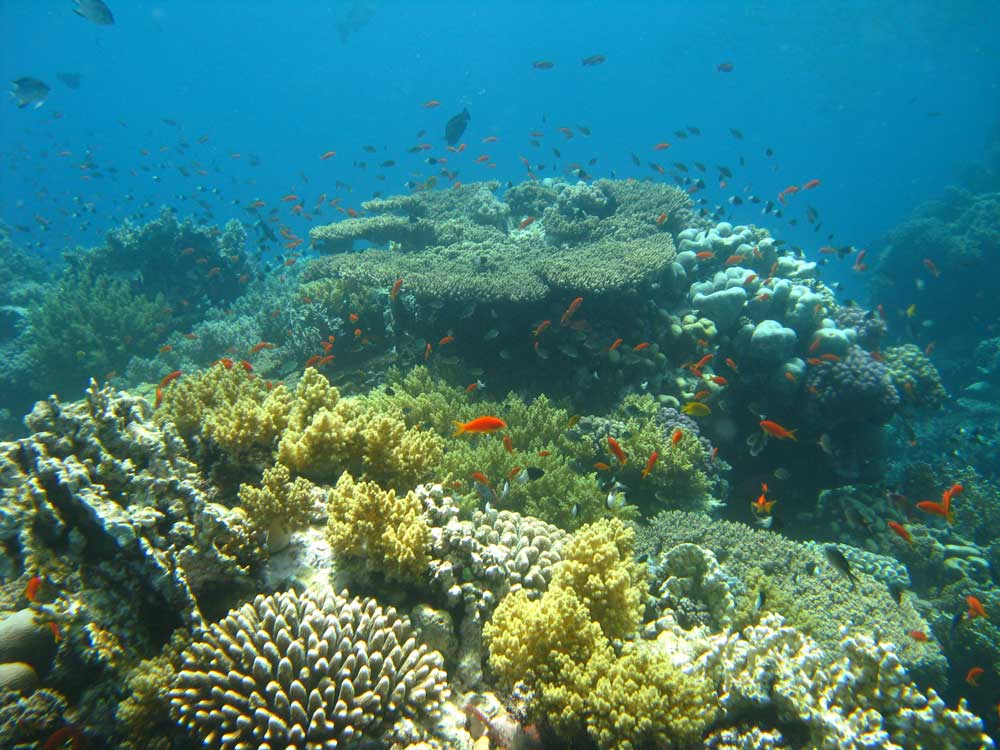
Coral reefs are among the most extraordinary and biologically diverse ecosystems on Earth. Although they cover less than 0.1% of the ocean floor, they support more than one-third of all marine species and provide food, livelihoods and coastal protection for hundreds of millions of people worldwide. [1][2]
Yet today they are disappearing at an alarming rate.
~ ~ ~ 🪸 ~ ~ ~
A Global Biodiversity Hotspot
Often called the “rainforests of the seas”, coral reefs are among the most species-rich ecosystems on Earth. They are home to more than 4,000 species of coral reef fishes, representing approximately one-third of all known marine fish species. [1][3]
These remarkable ecosystems are the result of millions of years of evolution. In addition to their extraordinary fish diversity, they support around 800 species of reef-building stony corals, together with countless invertebrates, sponges, crustaceans, molluscs and many other marine organisms. Overall, coral reefs provide habitat for more than one-third of all marine species, making them one of the world’s greatest biodiversity hotspots. [1][3]
Coral reefs grow remarkably slowly—often only a few centimetres each year. They are built by billions of tiny colonial animals, known as scleractinian corals, whose calcium carbonate skeletons have created some of the largest living structures on Earth, including Australia’s Great Barrier Reef. [4]
~ ~ ~ 🪸 ~ ~ ~
Did you know?
- Coral reefs cover less than 0.1% of the ocean floor. [1]
- They support more than one-third of all marine species. [3]
- More than 4,000 coral reef fish species live on coral reefs. [5]
- Healthy coral reefs support the livelihoods of over 600 million people worldwide. [2][6]
~ ~ ~ 🪸 ~ ~ ~
Ancient Ecosystems Under Threat
Despite their extraordinary importance, coral reefs are among the most threatened ecosystems on Earth.
Climate change is now considered the greatest global threat to coral reefs. Rising ocean temperatures have caused repeated mass bleaching events, while ocean acidification reduces the ability of corals to build their calcium carbonate skeletons. Studies show that the Great Barrier Reef has lost more than half of its coral cover since 1995 as a result of marine heatwaves and other climate-related disturbances. [7][8]
Coral reefs are also affected by overfishing, pollution, sedimentation, coastal development and destructive fishing practices, placing additional pressure on ecosystems already stressed by climate change. [2][9]
According to the Intergovernmental Panel on Climate Change (IPCC), global warming of 1.5°C could result in the loss of 70–90% of the world’s coral reefs, while warming of 2°C could lead to their near-complete disappearance. Current projections indicate that, without rapid and substantial reductions in greenhouse gas emissions, both warming thresholds are likely to be exceeded during this century. [10][11]
~ ~ ~ 🪸 ~ ~ ~
Why Coral Reefs Matter
Coral reefs are far more than spectacular underwater landscapes.
They provide food security, employment and income for hundreds of millions of people. They serve as nursery grounds for countless marine species, support fisheries and tourism, protect tropical coastlines from waves and storm surges, and contribute to the formation and stability of many tropical islands. [2][6]
The annual global economic value of healthy coral reefs has long been estimated to be at least USD 30 billion, including approximately USD 5.7 billion generated through reef fisheries alone; however, more recent assessments suggest that this is a conservative lower-bound estimate, with coral-reef-related tourism alone valued at nearly USD 36 billion annually and total coral reef goods and services estimated at USD 2.7 trillion per year [12][13][14]
Protecting coral reefs is therefore not only a matter of conserving biodiversity—it is also essential for safeguarding human livelihoods, food security and coastal communities.
~ ~ ~ 🪸 ~ ~ ~
Why Understanding Coral Reefs Matters
Public awareness of coral reefs—and of the remarkable diversity of fishes that inhabit them—remains surprisingly limited.
While climate change represents the greatest long-term threat to coral reefs, other human pressures—including the international trade in coral reef organisms—can be addressed more directly through improved monitoring, transparent trade data and informed conservation decisions.
Understanding these pressures is an essential first step towards protecting both coral reefs and the remarkable fishes that depend on them.
~ ~ ~ 🪸 ~ ~ ~
References
[1] Reaka-Kudla, M.L. (1997). The Global Biodiversity of Coral Reefs: A Comparison with Rain Forests. In: Biodiversity II: Understanding and Protecting Our Biological Resources. National Academy Press. https://www.researchgate.net/publication/239063261
[2] IPBES (2019). Global Assessment Report on Biodiversity and Ecosystem Services. https://ipbes.net/global-assessment
[3] Fisher, R. et al. (2015). Species richness on coral reefs and the pursuit of convergent global estimates. Current Biology, 25, 500–505. https://doi.org/10.1016/j.cub.2014.12.022
[4] Veron, J.E.N. (2000). Corals of the World. https://www.coralsoftheworld.org/page/home/
[5] Nelson, J.S., Grande, T.C. & Wilson, M.V.H. (2016). Fishes of the World (5th edition). Wiley. https://onlinelibrary.wiley.com/doi/book/10.1002/9781119174844
[6] United Nations Environment Programme (UNEP). Coral Reefs. https://www.unep.org/topics/ocean-seas-and-coasts/blue-ecosystems/coral-reefs
[7] De’ath, G., Fabricius, K.E., Sweatman, H. & Puotinen, M. (2012). The 27-year decline of coral cover on the Great Barrier Reef and its causes. Proceedings of the National Academy of Sciences, 109, 17995–17999. https://doi.org/10.1073/pnas.1208909109
[8] Dietzel, A., Bode, M., Connolly, S. R., & Hughes, T. P. (2020). Long-term shifts in the colony size structure of coral populations along the Great Barrier Reef. Proceedings of the Royal Society B: Biological Sciences, 287(1936), 20201432. https://doi.org/10.1098/rspb.2020.1432
[9] Hughes, T.P. et al. (2017). Global warming and recurrent mass bleaching of corals. Nature, 543, 373–377 https://doi.org/10.1038/nature21707
[10] IPCC (2018). Global Warming of 1.5°C. https://www.ipcc.ch/sr15
[11] IPCC (2022). Climate Change 2022: Impacts, Adaptation and Vulnerability. https://www.ipcc.ch/report/ar6/wg2Cesar, H., Burke, L., & Pet-Soede, L. (2003). The economics of worldwide coral reef degradation. Cesar Environmental Economics Consulting / WWF.
[12] Cesar, H., Burke, L., & Pet-Soede, L. (2003). The economics of worldwide coral reef degradation. Cesar Environmental Economics Consulting / WWF.
[13] Spalding, M., Burke, L., Wood, S. A., Ashpole, J., Hutchison, J., & zu Ermgassen, P. (2017). Mapping the global value and distribution of coral reef tourism. Marine Policy, 82, 104–113. https://doi.org/10.1016/j.marpol.2017.05.014
[14] Souter, D., Planes, S., Wicquart, J., Logan, M., Obura, D., & Staub, F. (Eds.). (2021). Status of coral reefs of the world: 2020 report. Global Coral Reef Monitoring Network / International Coral Reef Initiative. https://doi.org/10.59387/WOTJ9184